

The rapid adoption of generative artificial intelligence and Large Language Models (LLMs) has fundamentally transformed how modern software engineers, system administrators, and site reliability engineers troubleshoot complex application bugs. When a production environment fails, an application throws a standard stack trace, or a database query returns an unhandled exception block, the immediate reflex for many technical professionals is to copy the raw terminal output and paste it directly into an interactive AI terminal like ChatGPT to obtain an instant resolution blueprint.
While this workflow delivers immediate, actionable debugging solutions, it introduces a critical operational vulnerability that directly threatens established corporate governance frameworks. Pasting production logs into public AI tools bypasses conventional enterprise boundaries, strips away foundational compliance guardrails, and exposes sensitive institutional assets to systemic data storage mechanisms.
1. The Anatomy of an Unstructured Data String Link
To understand why this practice conflicts with governance standards, one must analyze the raw composition of system output fields. Unlike structured application payloads, such as highly managed relational tables or isolated data points protected by rigid access controls production system logging files represent massive, unpredictable fields of unstructured data strings.
[2026-07-11 14:32:01] production.ERROR: PDOException: SQLSTATE[23000]: Integrity constraint violation: 1062 Duplicate entry 'user.alpha@enterprise-client.com' for key 'users.email' in /var/www/core/Database/Connection.php:482
Stack trace:
#0 /var/www/core/Database/Connection.php(482): PDOStatement->execute()
#1 /var/www/core/Auth/SessionManager.php(114): DB::table('users')->insert(Array)
#2 /var/www/core/Http/Controllers/Auth/LoginController.php(42): SessionManager->initiateClientSession('user.alpha@enterprise-client.com', 'Bearer eyJhbGciOiJIUzI1NiIsInR5cCI6IkpXVCJ9...')
When an application records an error state, the resulting console strings capture the exact running state of the computational stack at the moment of failure. These raw log dumps routinely encompass broad, high-risk data parameters including:
- Explicit Personal Identifiers: Active system emails, customer phone numbers, home physical addresses, and transactional billing variables processed during the running execution thread.
- System Architecture Footprints: Absolute internal server directory paths, explicit container naming formats, hidden microservice dependencies, and local environment network parameters.
- Database Schema Configurations: Exact database table titles, conflicting indexing names, unique key properties, and raw parameter attributes.
- Secret Authentication States: Stray authorization headers, exposed JSON Web Tokens (JWTs), temporary session API keys, and internal microservice handshake tokens.
When an engineer copies an unscrubbed block of error telemetry, they are not just submitting an abstract programming problem to an external engine. They are uploading a highly detailed, contextual map of their company's internal software mechanics and active client interactions wrapped inside a single unstructured payload block.
2. Unintended Training-Set Inclusion Mechanisms
The core risk of interacting with public AI systems lies in the data retention policies that govern standard consumer web portals. When a user logs into a public LLM interface and pastes information into a standard prompt window, the transactional text boundary does not function as a closed, volatile memory cycle. Instead, unless an enterprise has explicitly configured specialized API endpoints or premium workspace boundaries with strict data exclusions, standard inputs are processed directly through the provider's active model lifecycle.
This processing model creates an immediate risk of unintended training-set inclusion. Public AI platforms continuously utilize historical prompt histories to refine, evaluate, and train future iterations of their deep learning networks.
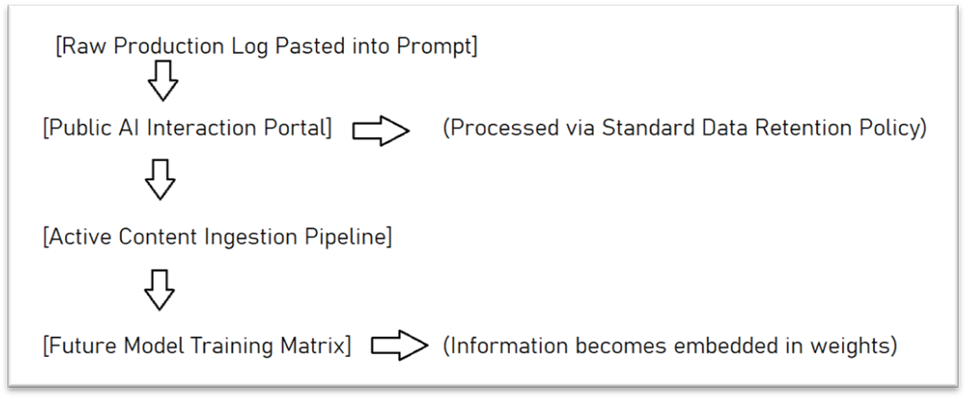
Once a production log string is ingested by the model's training pipeline, the proprietary technical information becomes permanently embedded within the multi-dimensional parameter weights of the network. Because these systems operate on complex probabilistic relationships rather than localized data silos, the ingested information cannot be selectively targeted or deleted from the neural network's underlying weights.
Consequently, highly specific system patterns, corporate architectural designs, or proprietary logic blocks risk becoming part of the model’s public knowledge base. This creates a downstream vulnerability where external users could prompt the same public engine for specific architecture solutions and accidentally trigger a response that surfaces elements of your proprietary technical structure.
3. The Reality of Public LLM Prompt Leaks
The threat of exposing intellectual property or client profiles through public AI engines is not a theoretical speculation; it represents a documented attack vector known as public LLM prompt leaks. As artificial intelligence models become increasingly integrated into global work environments, security researchers have demonstrated multiple techniques to extract historical training data from public models.
Through systematic prompt engineering methods including adversarial jailbreaking, context-hijacking, and targeted extraction queries external actors can induce public models to drift outside their standard operating bounds. If a model has ingested unredacted production telemetry during past training cycles, an adversary targeting specific corporate infrastructure patterns may successfully trigger the retrieval of those embedded string layers.
[Adversarial Extraction Prompt] ──► [Public LLM Core] ──► [Outputs leaked corporate telemetry]
A leak of this scale instantly transforms basic debugging logs into a critical intelligence map for malicious actors. If an attacker extract logs that detail exact software versions, known unhandled exceptions, or database validation vulnerabilities, they can design highly targeted exploits to bypass your production application perimeter without needing to scan your network externally.
4. Violating the Corporate Security Protocol Matrix
Every modern digital enterprise operates under a formalized corporate security protocol designed to establish hard boundaries between protected internal data networks and untrusted external web services. These protocols dictate how data must be classified, processed, and transmitted across both physical and cloud infrastructures.
Pasting production data logs directly into an external web browser form violates several core tenets of enterprise security architecture:
Loss of Cryptographic Access Visibility
Standard corporate perimeters rely on end-to-end encryption keys, strict role-based access controls (RBAC), and immutable security logs to track exactly who views production data. Moving that data into a public web interface completely destroys this visibility loop. Security teams lose all capability to track, audit, or verify where that sensitive information goes, who accesses it, or how long it remains cached on external nodes.
Bypassing Third-Party Vendor Evaluation Pipelines
Enterprise data protocols strictly forbid transmitting company assets to an external entity without a formal corporate vendor assessment. This assessment evaluates the third party's physical server security, employee background screenings, corporate insurance liability limits, and disaster recovery architectures. Utilizing standard public AI portals bypasses this evaluation pipeline entirely, exposing the enterprise to unverified infrastructure risks.
Prohibited Cross-Border Data Transfers
Many public cloud frameworks route standard web data across a decentralized array of global data hubs to balance processing loads. Pasting client data logs into a public terminal means your unstructured text payloads could be actively processed or cached on hardware located outside your domestic jurisdiction. This can trigger direct compliance violations for international operations that mandate strict regional boundary containment for user data.
5. Realigning Workflows with a Data Governance Framework
To mitigate the systemic risks of public AI exposure while still allowing development teams to leverage the speed of artificial intelligence assistance, organizations must enforce a modern, comprehensive data governance framework. This framework must transition the enterprise away from unregulated public prompt interactions and toward highly auditable, local-first sanitization architectures.
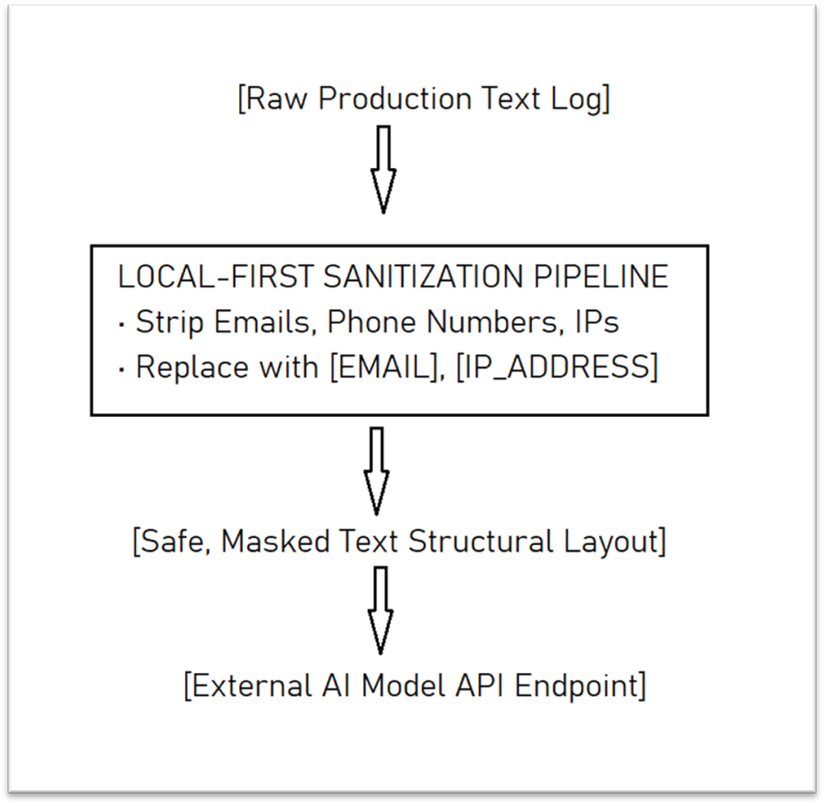
A resilient enterprise data governance framework consists of three structural operational layers:
Layer 1: Mandatory Local-First Pre-Filtering
Before any raw text block leaves a developer's desktop or cloud workstation, it must pass through an automated localized sanitization tool. This step ensures that all core identifiers including IP addresses, database schemas, full user names, email strings, and financial profiles are programmatically stripped out and replaced with standard semantic markers like [REDACTED_IP] or [MASKED_EMAIL]. This process preserves the underlying linguistic syntax and structural context of the log file, allowing the AI to successfully analyze the error mechanics without ever exposing real corporate data assets.
Layer 2: Dedicated Private Enterprise API Boundaries
Organizations should restrict all development teams from using standard, ad-supported consumer AI front-ends. Instead, technical teams must interact with models exclusively through dedicated enterprise API endpoints or premium workspace plans that feature explicit contractual data protection riders. These agreements must legally mandate that all incoming prompt payloads are completely excluded from future training loops, isolated from public model memory pools, and set to automatically purge from temporary system caches within 30 days.
Layer 3: Immutable Automated Audit Logging
Every interaction with external model architectures should pass through an internal corporate gateway proxy. This gateway acts as an automated audit log, tracking the employee's ID, the targeted model endpoint, and the exact volume of data transmitted. Continuous automated scans can then inspect outbound prompts for compliance anomalies, instantly flagging any accounts that attempt to pass raw, unmasked data packages out of the secure network environment.
Summary Matrix: Public Ingestion vs. Governed Architecture
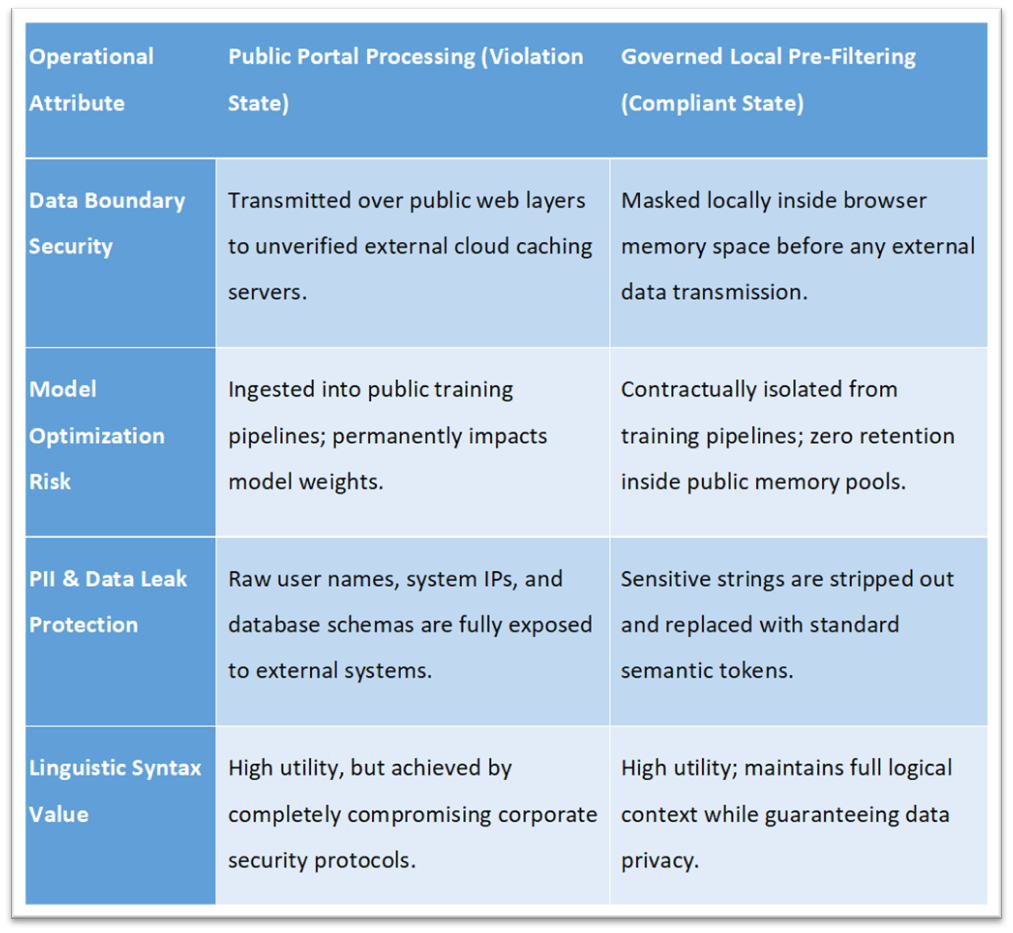 Operational Attribute
Transmitted over public web layers to unverified external cloud caching servers.
Masked locally inside browser memory space before any external data transmission.
Model Optimization Risk
Ingested into public training pipelines; permanently impacts model weights.
Contractually isolated from training pipelines; zero retention inside public memory pools.
PII & Data Leak Protection
Raw user names, system IPs, and database schemas are fully exposed to external systems.
Sensitive strings are stripped out and replaced with standard semantic tokens.
Linguistic Syntax Value
High utility, but achieved by completely compromising corporate security protocols.
High utility; maintains full logical context while guaranteeing data privacy.
Conclusion
The engineering efficiency gained from leveraging generative AI to debug production failures cannot be ignored, but it must not come at the expense of corporate compliance and data security. Pasting unredacted production logs into public platforms like ChatGPT introduces severe governance risks, including public prompt leaks and unintended training-set inclusion.
By implementing a rigorous data governance framework that centers on local-first text sanitization and secure enterprise API channels, organizations can successfully leverage the analytical power of modern LLMs. This balance allows development teams to resolve system errors at lightning speed while keeping proprietary corporate assets and sensitive user data fully protected within the secure corporate perimeter.
Ready to Sanitize Your Session?
Use our professional-grade web utility to clear local data traces immediately.
Open Sanitizer Tool