

As engineering teams rush to integrate generative artificial intelligence into core business applications, data privacy has emerged as a significant technical bottleneck. Connecting internal software ecosystems to public or third-party Large Language Model (LLM) APIs means that user queries, system diagnostic scripts, and database results travel outside the corporate firewall. If any of this data contains Personally Identifiable Information (PII), your software architecture may instantly violate regulatory frameworks like GDPR, CCPA, or HIPAA.
To bypass this risk, forward-thinking software engineers are moving away from reactive post-processing security models. Instead, the modern standard relies on proactive architectural design: implementing an inline, client-side filtering layer. This guide delivers an end-to-end technical blueprint for building a local PII middleware gateway that cleans text strings directly inside client runtime memory before any network payload crosses the external cloud boundary.
1. Architectural Strategy: The Power of Local Interception
Relying on a remote cloud firewall to scrub sensitive records right before they hit an AI model introduces a flawed paradigm. If raw user text travels to a centralized security server first, you have already moved the data onto a remote network infrastructure, creating an unnecessary attack vector and generating log trails that must be managed, encrypted, and audited.
A more secure alternative is a architecture centered on a local proxy intercept. By capturing outbound prompt structures directly inside the client browser sandbox or local terminal node, you establish a true zero-trust boundary.
[Raw User Text Prompt]
│
▼
┌───────────────────────────────────────┐
│ CLIENT-SIDE RUNTIME ENVIRONMENT │
│ (Local Proxy Intercept / Sandbox Memory) │
│ │
│ 1. Evaluate string configurations │
│ 2. Apply regular expression filters │
│ 3. Map tokens to string replacement arrays │
└──────────────────────────────────────┘
│
▼
[Anonymized Semantic Token String]
│
▼
(Outbound HTTPS)
│
▼
[External AI Provider Infrastructure]
Executing this client-side filtering logic guarantees that sensitive user strings are intercepted and stripped out while still held within volatile system memory. The external cloud provider receives a clean layout of text that preserves logical structures but contains zero trace of tracking markers, billing accounts, or proprietary credentials.
2. Setting Up the Gateway Core Engine
A local middleware layer must run with minimal processing overhead. If your pre-filtering script stalls application performance, developers or users will look for workarounds to bypass it. Utilizing native, client-side JavaScript execution provides a highly optimized solution that runs at sub-millisecond speeds directly inside the user's browser memory loop.
Below is a production-grade blueprint for an inline data sanitization gateway. This framework establishes structural detection patterns, sets up a token dictionary, and builds an execution bridge to safely process raw string layouts.
JavaScript
/**
* Local Data Anonymization Middleware Gateway Core
* Executed locally within the browser runtime sandbox.
*/
class LocalPrivacyGateway {
constructor() {
// High-confidence matching patterns for primary tracking variables
this.filterPatterns = {
email: /[a-zA-Z0-9._%+-]+@[a-zA-Z0-9.-]+\.[a-zA-Z]{2,}/g,
phone: /\b(?:\+?1[-.\s]?)?\(?\d{3}\)?[-.\s]?\d{3}[-.\s]?\d{4}\b/g,
ssn: /\b\d{3}-\d{2}-\d{4}\b/g,
creditCard: /\b(?:\d{4}[-\s]?\d{4}[-\s]?\d{4}[-\s]?\d{4}|\d{13,19})\b/g,
ipv4: /\b(?:\d{1,3}\.){3}\d{1,3}\b/g,
jwt: /eyJhbGciOiAiSFMyNTYiLCAidHlwIjogIkpXVCJ9\.[a-zA-Z0-9-_]+\.[a-zA-Z0-9-_]+/g
};
// Initialize state tracker for deterministic token tracking
this.tokenVault = new Map();
this.vaultCounter = 0;
}
/**
* Executes client-side filtering logic across an outbound payload
* @param {string} rawPrompt - The unshielded raw input string
* @return {string} The fully anonymized text layout
*/
sanitizePayload(rawPrompt) {
if (!rawPrompt || typeof rawPrompt !== 'string') return '';
let processedText = rawPrompt;
// Loop through active matching definitions to construct replacement maps
for (const [dimensionType, expression] of Object.entries(this.filterPatterns)) {
processedText = processedText.replace(expression, (matchedString) => {
return this.registerToken(dimensionType, matchedString);
});
}
return processedText;
}
/**
* Registers a unique token within the temporary local string replacement arrays
*/
registerToken(type, secretValue) {
// Prevent registering duplicates to maintain text evaluation paths
for (const [token, storedValue] of this.tokenVault.entries()) {
if (storedValue === secretValue) return token;
}
this.vaultCounter++;
const dynamicToken = `[REDACTED_${type.toUpperCase()}_${this.vaultCounter}]`;
this.tokenVault.set(dynamicToken, secretValue);
return dynamicToken;
}
/**
* Clears session storage maps to guarantee zero physical data footprint
*/
flushVault() {
this.tokenVault.clear();
this.vaultCounter = 0;
}
}
3. Implementing String Replacement Arrays & Context Mapping
A simple script that deletes sensitive words or drops blank spaces into a prompt will fail in an AI context. Large Language Models rely on structural linguistic relationships, context clues, and syntactic frameworks to interpret instructions correctly. If an error log loses its structure, the resulting AI analysis will be highly inaccurate.
To fix this, the code template above utilizes deterministic string replacement arrays. Instead of throwing away strings entirely, the engine maps found patterns to custom, context-aware placeholders like [REDACTED_EMAIL_1] or [REDACTED_PHONE_2].
Preserving Logical Code Layouts
By replacing actual customer variables with standardized, structural placeholders, you ensure the code structure remains completely intact. The AI engine can still easily see that an application controller failed during a database lookup because of a duplicate record error, but it won't see the actual user email address that caused the failure.
Enabling Reverse Hydration Loops
Because the localized middleware retains these relationship pairings within a volatile browser Map() structure (this.tokenVault), your system can run a reverse mapping loop. When the external AI engine finishes generating its troubleshooting steps or code fix, the local application intercept can catch the incoming text stream and substitute the original user variables back into the text panel. This gives the end-user a seamless, highly context-rich experience while ensuring that the external AI provider's servers never process or store a single byte of sensitive information.
4. Deploying the Engine as an API Text Pre-Processing Layer
To ensure every developer on your team uses this privacy layer, the client-side middleware script should be directly attached to your global outbound network handler. Integrating this script as a mandatory API text pre-processing interceptor ensures that all outbound prompt streams are automatically sanitized before they are sent over the network.
Here is an enterprise-ready implementation using the native browser Fetch API to automatically intercept, process, and securely route outbound AI prompts:
JavaScript
// Instantiate the privacy gateway inside your application wrapper
const PrivacyGateway = new LocalPrivacyGateway();
async function sendSecureAIPrompt(userInput) {
const aiEndpoint = "https://api.external-ai-provider.com/v1/chat/completions";
// 1. Intercept and clean the payload before it can touch the network layer
const safeCleanText = PrivacyGateway.sanitizePayload(userInput);
const payloadBody = {
model: "gpt-4o",
messages: [
{
role: "user",
content: safeCleanText // The AI only ever receives the safe layout
}
],
temperature: 0.2
};
try {
// 2. Submit the anonymized text format over the outbound network connection
const networkResponse = await fetch(aiEndpoint, {
method: "POST",
headers: {
"Content-Type": "application/json",
"Authorization": "Bearer sk-proj-ENTERPRISE_API_KEY_HERE"
},
body: JSON.stringify(payloadBody)
});
const rawData = await networkResponse.json();
let aiOutput = rawData.choices[0].message.content;
// 3. Local Hydration: Safely restore structural context for the user
PrivacyGateway.tokenVault.forEach((originalValue, tokenPlaceholder) => {
aiOutput = aiOutput.replaceAll(tokenPlaceholder, originalValue);
});
// 4. Flush volatile session parameters to eliminate data trail risks
PrivacyGateway.flushVault();
return aiOutput;
} catch (networkError) {
console.error("Secure Gateway Processing Interrupted:", networkError);
PrivacyGateway.flushVault();
throw networkError;
}
}
5. Security Validation and Operational Guardrails
Deploying client-side filtering logic requires strict adherence to memory hygiene protocols to prevent local data exposure. Engineers must enforce the following validation standards across their applications:
- Volatile Memory Storage: Always keep your token vaults bound to isolated runtime variables like a JavaScript Map or a private class state. Never save raw transaction text or mapping tables to persistent browser spaces like localStorage or IndexedDB, as these locations leave text exposed to cross-site scripting (XSS) attacks.
- Deterministic Processing Cycles: Always run your scrubbing routines during the active request cycle immediately before generating the network packet. This design ensures that text data remains fully shielded from external browser extensions or unverified third-party analytics trackers running in background tabs.
- Continuous Pattern Synchronization: Keep your core regular expression definitions updated to capture international variations in phone formats, alphanumeric account structures, and emerging token standards used by cloud architectures.
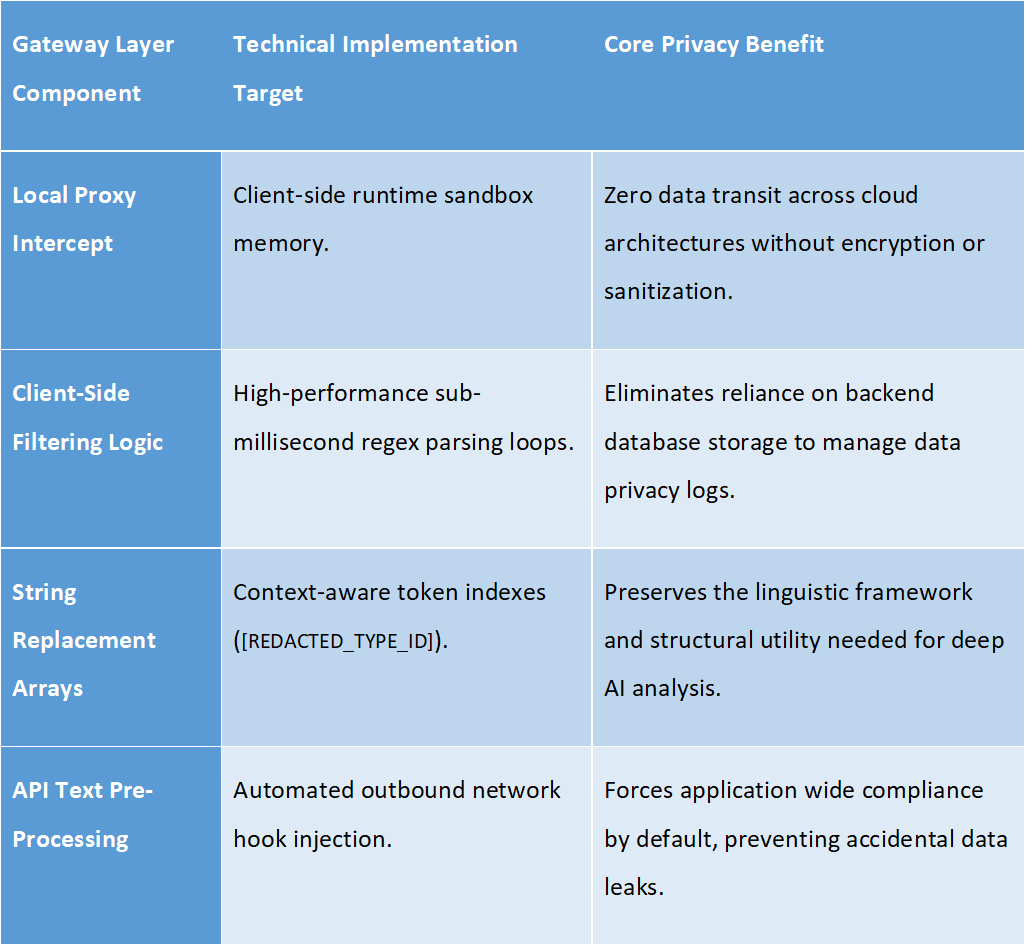
Conclusion
Building a local PII middleware gateway transitions your enterprise AI infrastructure into a true privacy-by-design model. Intercepting raw text data streams at the client level, utilizing high-performance string replacement arrays, and enforcing strict API text pre-processing ensures your application can fully harness the power of modern Large Language Models. This robust architecture enables your development teams to build fast, AI-driven applications while keeping sensitive data completely isolated, secure, and under your absolute control.
Ready to Sanitize Your Session?
Use our professional-grade web utility to clear local data traces immediately.
Open Sanitizer Tool